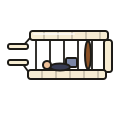
The first powered aeroplane flight took place on 17 December 1903, which makes it 123 years old in 2026. Orville Wright flew the Wright Flyer 37 metres in 12 seconds near Kitty Hawk, North Carolina. The brothers flew four times that day, and Wilbur’s last flight covered 260 metres in 59 seconds.
First powered flight17 December, 10:35 in the morning
1908118 years ago
Wilbur amazes crowds at Le Mans, France
192898 years ago
Orville sends the Flyer to the Science Museum, London
194878 years ago
The Flyer returns to the Smithsonian
The first flight, 17 December 1903
At 10:35 in the morning, at Kill Devil Hills about four miles south of Kitty Hawk, Orville Wright released the wire holding the Flyer on its launching rail. Into a 27 mph headwind it rose, wobbled and landed about 120 feet (37 metres) away, 12 seconds later. Wilbur ran alongside.
John T. Daniels, a man from the nearby lifesaving station, squeezed the bulb of the brothers’ camera just as the machine left the ground. His picture is one of the most famous photographs ever taken.
The brothers took turns and flew four times. On the fourth flight Wilbur covered 852 feet (260 metres) in 59 seconds. Soon afterwards a gust of wind flipped the Flyer over and damaged it badly. It never flew again.
How two bicycle makers built the first aeroplane
Wilbur and Orville Wright ran a bicycle shop in Dayton, Ohio, which paid for their experiments. They tested gliders on the dunes of the Outer Banks from 1900, where the wind was steady and the sand soft, and built their own wind tunnel in 1901 to measure how wings behaved.
Their key idea was control. Wires twisted, or “warped”, the wingtips so the pilot could bank and balance, much as a cyclist leans into a turn. No engine maker could supply one light enough, so their mechanic Charlie Taylor built a 12 horsepower engine in the shop. The finished Flyer had a wingspan of 12.3 metres and weighed about 274 kg empty.
Why the Flyer spent 20 years in London
For years the Smithsonian Institution gave credit for the first flyable aeroplane to its own former secretary, Samuel Langley, whose “Aerodrome” had plunged into the Potomac River just nine days before the Wrights flew. In protest, Orville shipped the original Flyer to the Science Museum in London in 1928.
The Smithsonian backed down in 1942. The Flyer came home after the Second World War and went on display in Washington on 17 December 1948, 45 years to the day after its first flight. It hangs today in the National Air and Space Museum.